
Thinking, Fast and Slow
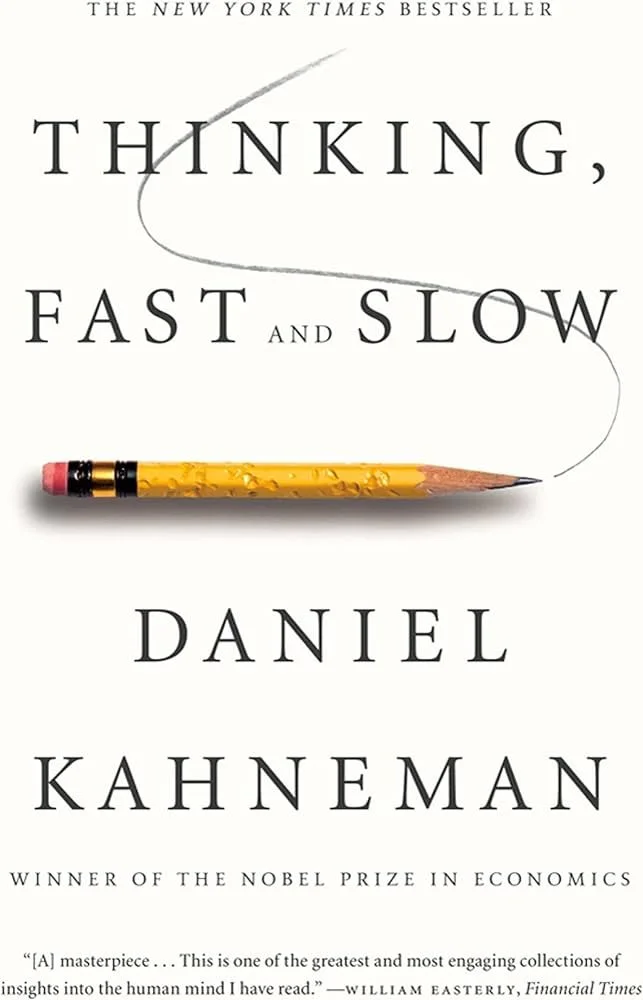
Thinking, Fast and Slow
Daniel Kahneman
What it’s about
Kahneman, the 2002 Nobel laureate in Economics, wrote this accessible yet rigorous book to explain how our minds work, why we so often make predictable errors in judgment, and when (and how) we can think better. It's structured around experiments, real-world examples, and personal reflections, making complex ideas feel conversational and urgent. The book has sold millions, influenced policy (e.g., "nudge" theory), finance, medicine, and everyday self-awareness.
At its heart is the distinction between two modes of thinking:
System 1: Fast, automatic, intuitive, emotional, effortless, associative, and largely unconscious. It's the hero of daily life—quick impressions, gut feelings, pattern recognition—but prone to biases and shortcuts.
System 2: Slow, deliberate, effortful, logical, analytical, and conscious. It handles complex calculations, self-control, and overriding impulses, but it's lazy and often defers to System 1 unless forced to engage.
Kahneman shows how System 1 dominates most of our mental life, leading to systematic errors (biases) that feel like truth.
Why I like it
Kahneman documents the core of our "Red Line" management critique. System 1 ignores what it doesn't know. It builds a coherent story based only on the information in front of it (the ‘red line’ observables), failing to account for the vast "Blue Line" reality of future uncertainty and hidden risks.