
The Ascent of Money
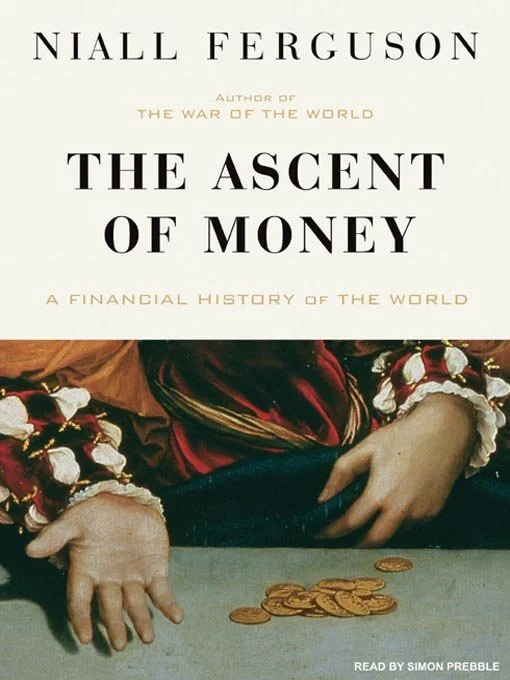
The Ascent of Money:
A Financial History of the World
Niall Ferguson
What it’s about
Ferguson provides an engaging narrative tracing the evolution of finance from ancient Mesopotamia to the brink of the 2008 global financial crisis (and beyond in later editions). Ferguson, a historian known for big-picture storytelling, argues that money and financial innovation are not peripheral evils or mere tools but the essential "back story" to human progress—driving empires, wars, revolutions, and prosperity.
Ferguson portrays finance as an evolutionary process: innovations like double-entry bookkeeping, joint-stock companies, government bonds, and insurance funds enabled larger-scale cooperation, risk-sharing, and resource allocation than any prior system (feudalism, central planning). Yet it's prone to booms, busts, bubbles, and crises due to human psychology (greed/fear swings), uncertainty, and asymmetric information. The book ends with reflections on the 2008 meltdown, comparing finance to Darwinian evolution—adaptive, innovative, but ruthless.
Why I like it
Ferguson sees the world from a Shithappensian perspective where the forces of physics are simply playing out with the logical consequences eventually leading humans to create money. He sees the development of money and finance as an evolutionary process which is constantly tested against its ability to serve humans and provide well-being. Money enables the empowerment of the people and facilitates the allocation of resources based upon the benefits resulting from the allocation to the many. The reality of this is not well understood, but Ferguson ‘gets it’ and is able to explain it in this book.